
How to request and retrieve a book of business report
Below, you’ll find more information on the book of business report, including how to submit and retrieve book of business requests.
Please note:
- You must be logged in to Suncentral in order to use the book of business tool.
- The book of business information returned in your report will show information related to all advisor codes for which you currently have access.
- Users with access to branch codes will see a dropdown allowing book of business reports to be created for either individual branch codes or all branch codes for which you have access.
- Book of business requests may be submitted between 6 a.m. ET and 6 p.m. ET.
- Once submitted, book of business reports will be ready within 24 hours, and you will receive an email once it’s ready.
- Book of business reports are provided in an Excel spreadsheet format (.xls).
- Additional support in viewing and filtering your downloaded book of business report can be found here.
- Chrome is the recommended browser.
- Need additional help? Contact suncentral@sunlife.com.
1. Open a browser and navigate to Suncentral.
2. Log in using your Access ID and Password, or your firm’s single sign on (SSO), if available.. If you don’t have a Suncentral account, please refer to How to register for Suncentral.
3. Select the Tools page at the top of Suncentral, where you’ll find the Book of business report listed under Insurance Tools.
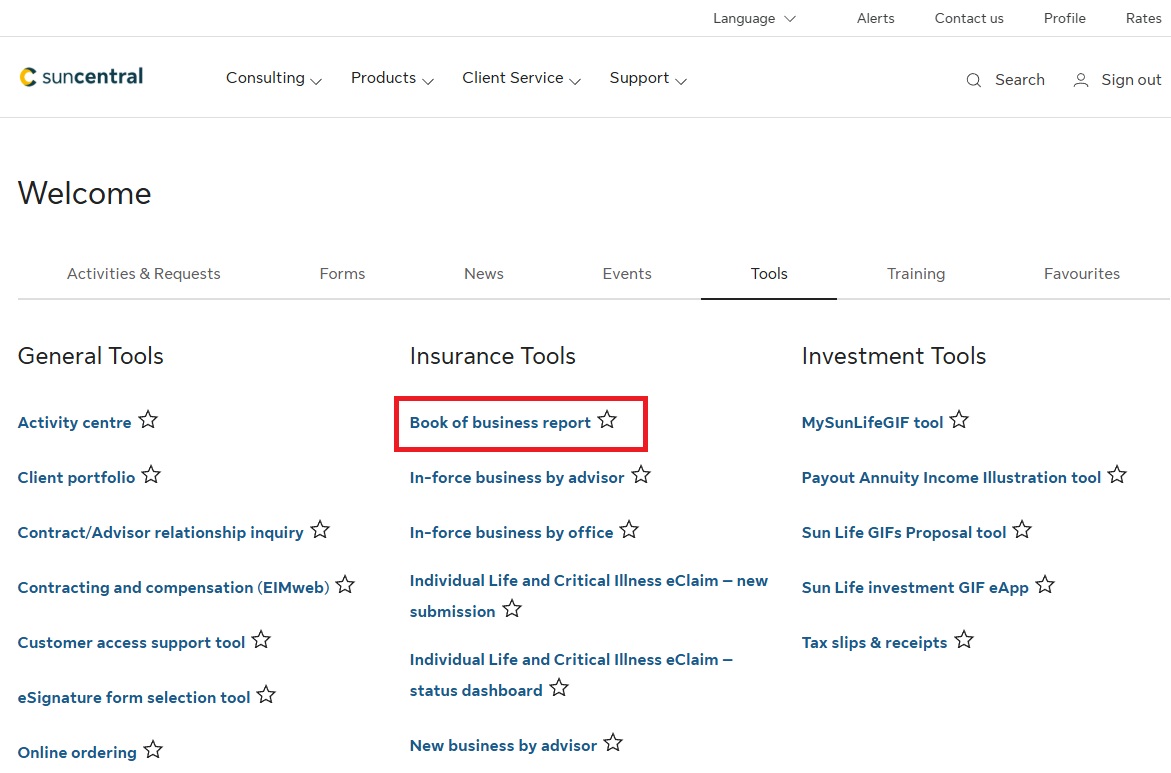
1. On the book of business report, select the Request a book of business report tab.
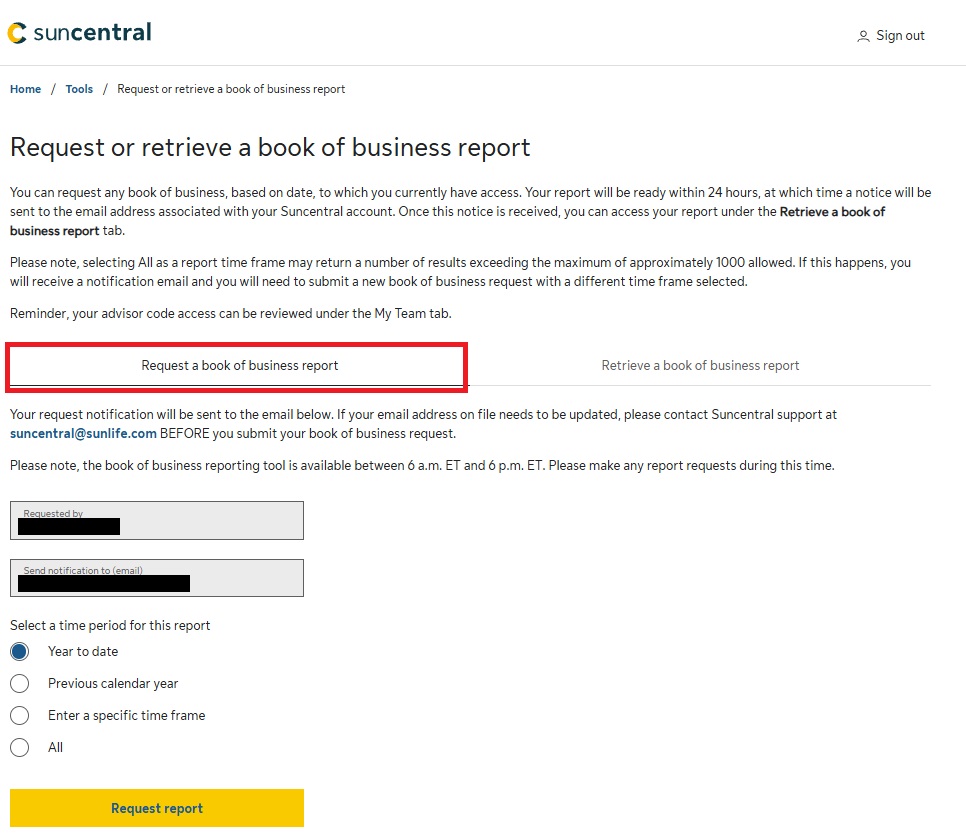
2. The user’s name and email will be prepopulated, based on your Suncentral login information and cannot be changed here.
Note: If this information is incorrect, please contact suncentral@sunlife.com.
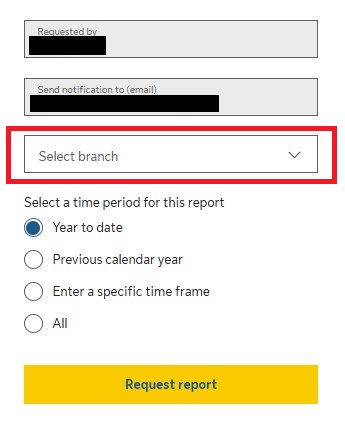
For users with branch-code access only:
You will see a screen similar to the one shown above, with the addition of a Select branch dropdown menu. From here you can select a single branch code or all branch codes for which you have access.
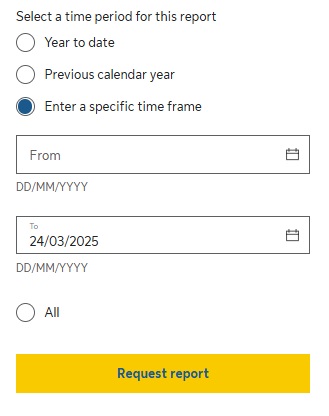
3. Select the time period for which you would like this report to cover. The report generated will show results for the time chosen and include all information for every advisor code for which you currently have access.
- Selecting Enter a Specific time frame lets you enter dates as early as January 1, 1900, up to today’s date
- If your selected time frame is too short and no data is returned for the report, you will be notified by email and will be asked to run a new report with a revised time frame.
- Selecting All will generate a book of business including all information for every advisor code you can currently access.
- Please note: There is a 1000-entry limit for each book of business report and selecting All may generate a report larger than this threshold. If this happens, you will be notified by email and will be asked to run a new report with a revised time frame.
4. Once you’ve entered your desired information, select Request report.
- Once selected, you will receive a message confirming that your report is being processed.
- Requests for book of business reports may be submitted between 6 a.m. ET and 6 p.m. ET.
- Once submitted, you will receive an email within 24 hours when your book of business report is ready
- If needed, you can request additional book of business report(s) before the previous report is delivered.
1. Once your book of business report is ready, you will receive an email notification with instructions on how to retrieve your report.
- If there is an error processing your report, likely due to no available information or a report exceeding the maximum-allowed file size, you will receive an email advising you of the specific issue, along with steps you can take to correct it and run the report again.
1. From Tools > Book of business report, select the Retrieve a book of business report tab.
- Please note that some declined policies are not displayed in your book of business reports. If this information is needed, it can be found in the client portfolio tool where you can see your client’s information and policy details.
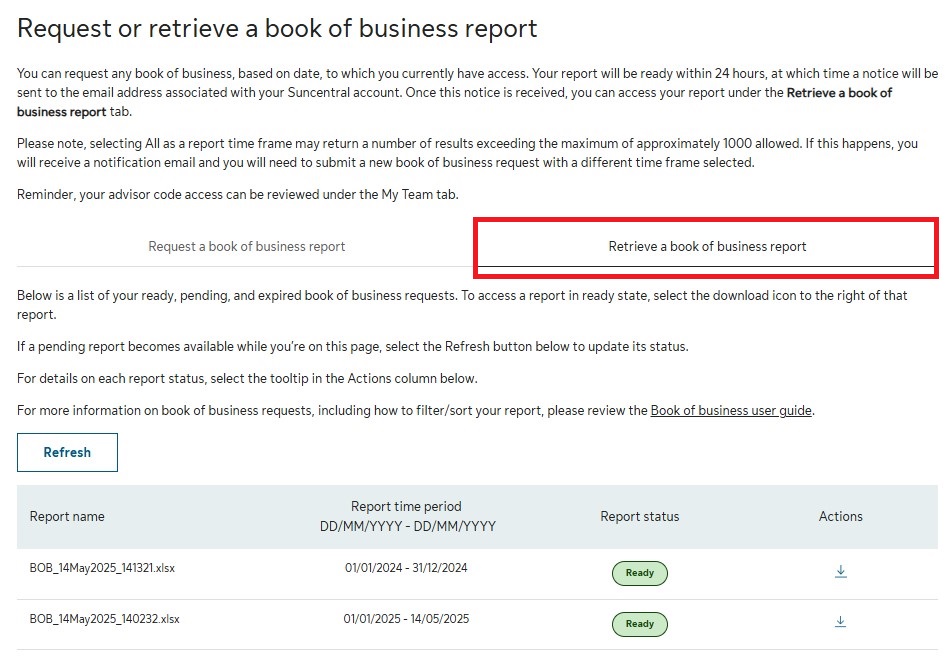
2. Locate the report you wish to download on the table. If you have received an email stating a report is ready but you don’t see it here, select the Refresh button.
For users with branch-code access only:
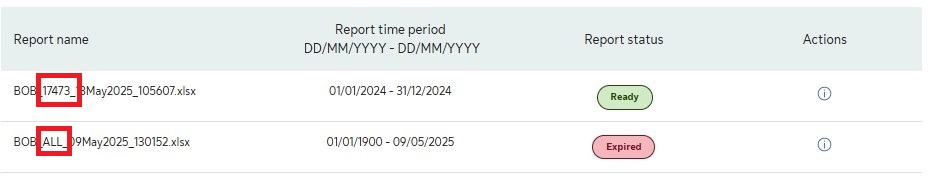
Your book of business report names will include the branch code number (see below). If “All” all branch codes were selected when requesting the report, “ALL” will appear in the filename.
3. Each report name on the table will be marked as one of the following (this information is available within the table by selecting the information icon in the far-right column):
- Ready – This report is complete and can be downloaded by selecting the download icon in the far-right column.
- Pending – This report has been submitted but is not yet ready for download. Once it’s ready, select the Refresh button and the status will change to Ready.
- Expired – This report was prepared and stored for the maximum allowed time of 30 days. If you wish to download this report, it must be submitted again under the Request a book of business report tab.
- Failed – This report failed to generate, most likely due to no results, or too many results (over 1000) for the time frame selected. Please revise your selected time frame and run the report again under the Request a book of business report tab.
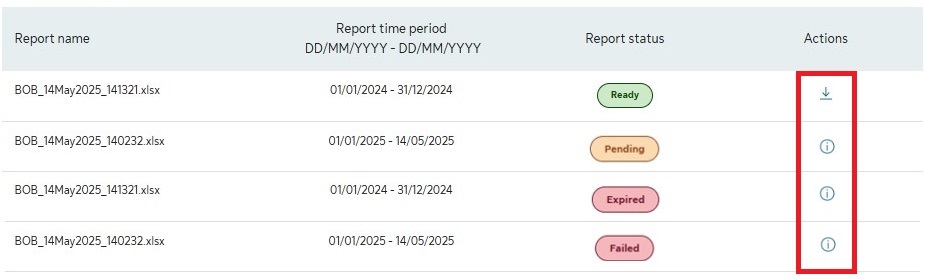
4. Selecting download will download the book of business report file in Excel spreadsheet format (.xls) to your browser.
Which fields are included in the Book of business report and what do they represent?
Sun Life policy and advisor data fields
- Branch number - Unique identifier for the branch location
- Branch name - Name of the business branch
- Advisor number - Unique identifier assigned to the financial advisor
- Advisor name - Full name of the financial advisor
- Advisor status - Current status of the advisor (e.g. active, inactive)
- Policy number - Unique identifier for the insurance policy (formatted AA123450)
- Policy status - Current state of the policy (e.g. active, lapsed, terminated)
- Policy issue date - Date the policy was originally issued
- Policy termination date - Date the policy was ended or cancelled
- Product Type - Category of the insurance product (e.g. life, disability, critical illness)
- Product name - Specific name of the insurance product
- Policy assigned - Indicator of policy assignment or ownership transfer
- Currency code - Currency used for premiums and benefits (e.g. CAD, USD)
- Premium amount per pay period - Payment amount for each premium payment
- Premium payment frequency code - How often premiums are paid (e.g. monthly, annual)
- Method of payment - How premiums are paid (e.g. bank draft, credit card, payroll deduction)
- Annualized premium - Total annual premium cost
- Policy renewal Date- I. Date on which policy’s renewal is due. For example, a 10-year term policy, renewal date would be 10 years after the policy-effective date.
- Coverage status - Current state of the insurance coverage
- Coverage effective date - Date coverage begins
- Coverage expiration date - Date coverage ends
- Coverage term conversion expiry date - Deadline to convert term coverage to permanent insurance
- Coverage plan face amount - Total benefit amount provided by the policy
- Policy owner name - Policy owner’s full name
- Policy owner DOB - Policy owner’s date of birth
- Policy owner gender - Policy owner’s gender
- Policy owner mailing address - Street address for policy-owner correspondence
- Policy owner city - Policy owner’s city of residence
- Policy owner province - Policy owner’s province of residence
- Policy owner country - Policy owner’s country of residence
- Policy owner postal code - Policy owner’s postal code
- Policy owner valid address indicator - Flag indicating whether the address is current and valid
- Name of insured - Full name of the person covered under the policy
- Coverage issue rating age - Age used for underwriting and rating purposes
- Coverage base plan indicator - Flag indicating if this is the primary/base coverage plan
- Beneficiaries - Individuals designated to receive policy benefits and indicates whether beneficiary is revocable
- Writing agent name - Full name of the agent who sold the policy
- Writing agent number - Unique identifier for the selling agent
- Commission % - Commission percentage earned on the policy
What if there are blank fields?
Not all data applies for all policies – if no information applies to a certain field, it will be left blank.